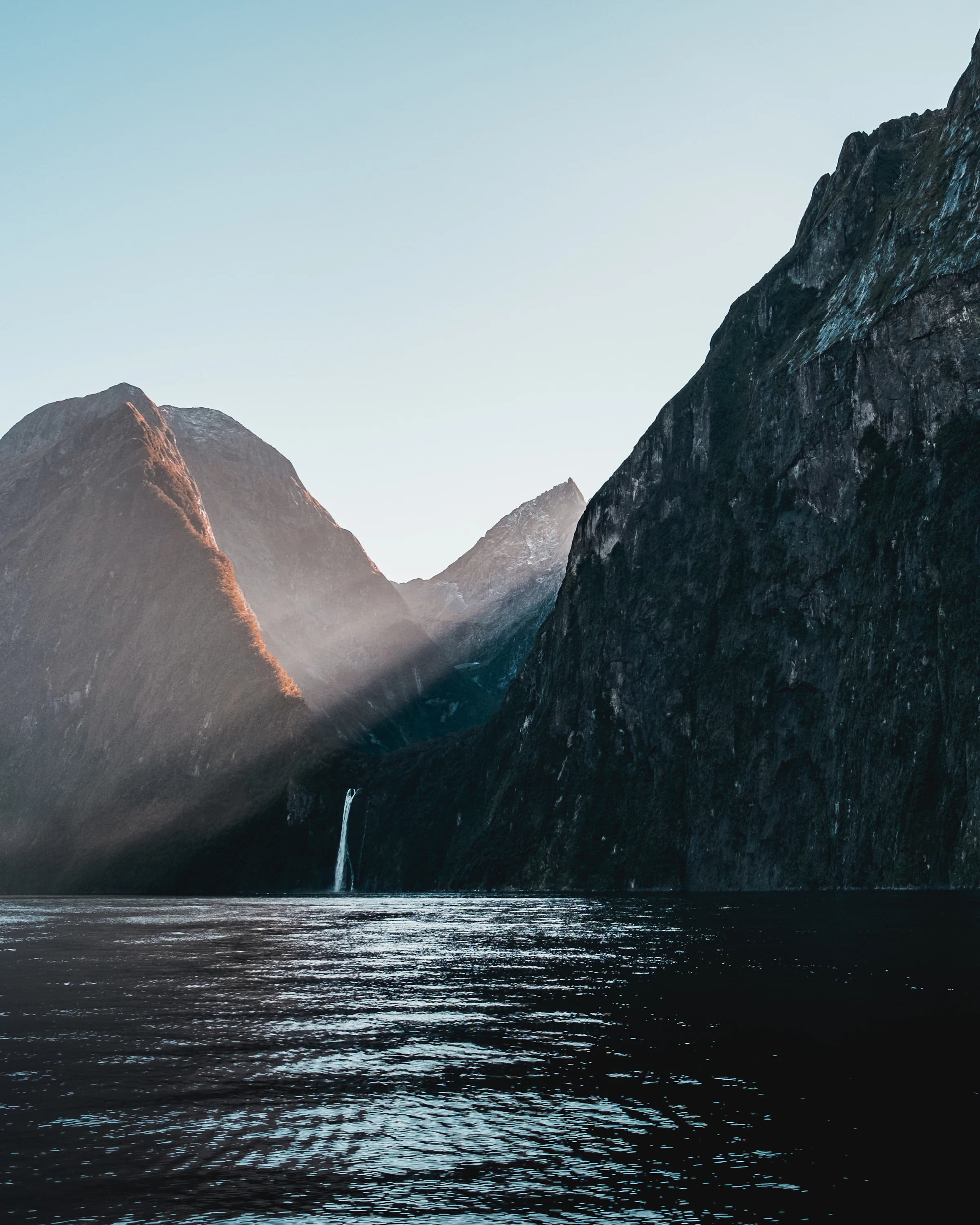
Milford Sound is genuinely one of the most spectacular places on earth. It's also one of the most visited — and the most rained on. This guide tells you when to go, what to book, and what nobody tells you in advance.
The Rain Question (Answer It First)
Milford Sound receives approximately 7 metres of rain per year. It rains around 200 days annually. This is, statistically, very likely to be one of them.
Here's what nobody tells you: rain at Milford Sound is good, not bad. When it rains, the fiord transforms — waterfalls that barely trickle on dry days become thundering cascades of white water on every cliff face. The clouds sit at mid-mountain level, revealing the cliff bases and fiord floor while the peaks vanish into the drama above. The Bowen Falls, which tumble 162 metres directly into the fiord, are spectacular in the rain in a way they simply aren't on a dry day.
A clear sunny day gives you the iconic Mitre Peak reflection shot and blue sky above. A rainy day gives you dozens of temporary waterfalls and cinematic atmosphere. Both are worthwhile — neither is a failure. The one weather condition that genuinely diminishes the experience is a thick, low mist that obscures the entire fiord top to bottom. Those days are rare.
Ask GuideNow: “It's raining at Milford Sound — is it still worth going?”
Getting There — Your Options
**Drive yourself (recommended if possible):** 120km from Te Anau (under 2 hours), 290km from Queenstown (4+ hours). The Milford Road is one of the great scenic drives in New Zealand — beech forest, Eglinton Valley, Homer Tunnel. Stop freely. Allow 2.5 hours from Te Anau with stops. In winter, chains may be required at the Homer Tunnel; the road occasionally closes after heavy snowfall — check NZTA conditions before leaving.
**Coach from Te Anau (Real Journeys):** The Milford Sound day trip package from Te Anau ($234 adult, $124 child) includes return coach and nature cruise. This is the cleanest single-booking option if you're staying in Te Anau.
**Coach transfer only (TrackNet):** $112 adult, $67 child return from Te Anau. Book cruise separately. Gives flexibility to choose your own cruise operator. Departs Te Anau at 6:55am.
**Day trip from Queenstown:** Long. Coachwork is approximately 4 hours each way. Most day trips from Queenstown run 5–6am to 8–9pm. The experience on the fiord is identical — the question is whether you want a 14-hour day for 2 hours on the water. Many people do it and consider it worth it. Staying in Te Anau overnight is the more considered approach.
**Scenic flight:** Helicopter or fixed-wing flight from Queenstown or Te Anau gives you Milford Sound, the surrounding Fiordland peaks, and potentially a glacier landing in under an hour each way. Expensive but incomparably efficient. Roughly $400–900+ NZD depending on operator and duration.
Price Guide (NZD)
Prices are indicative. Confirm with operators before booking.
Local Tips
- →Stay in Te Anau the night before — beats the Queenstown 5am start
- →Drive the Milford Road if you can — it's part of the experience
- →Check road conditions in winter: journeys.nzta.govt.nz
- →Prices as of June 2026 — confirm with operator before booking
Ask GuideNow: “Help me plan the best way to get to Milford Sound from where I am”
The Cruise — What to Book and Why
A cruise on the fiord is the core experience. The two main operators — Real Journeys and Southern Discoveries — run equivalent Nature Cruises at the same price ($179 adult, $99 child, under 5 free). Both are approximately 2 hours on the water, both pass Mitre Peak and the main waterfalls, and both offer commentary.
Real Journeys uses slightly larger vessels and runs more departures. Southern Discoveries tends to have fewer people per sailing — meaningful if you're choosing between same-priced options on a busy summer day.
Morning cruises (first departure, usually 10am) give the calmest water and best chance of Mitre Peak reflections on clear days. Afternoon cruises can have better light on the surrounding cliff faces. Either is good — the fiord experience doesn't depend significantly on time of day.
The 'overnight cruise' option (Real Journeys) is worth considering for those who want to experience Milford Sound at dusk and dawn. The fiord after 4pm, when day-trippers are gone, is a completely different place.
Price Guide (NZD)
Prices are indicative. Confirm with operators before booking.
Local Tips
- →Morning cruise: best for calm water and Mitre Peak reflections on clear days
- →Book at least 2 days ahead in December–February — sold out is real
- →Under 5 free on Real Journeys cruises
- →Prices as of June 2026 — confirm with operator before booking
Ask GuideNow: “Which Milford Sound cruise should I book today?”
Kayaking — The More Immersive Option
If you want to get off the cruise vessel and onto the water directly, Rosco's Milford Kayaks is the operator. Half-day guided kayak trips paddle to the face of Stirling Falls — a 155-metre waterfall you can paddle directly underneath. The water is cold, the scale is visceral in a way that a cruise vessel cannot replicate, and the guide commentary is genuinely good.
Tours are guided and require no kayaking experience. Minimum age is 8 years. The half-day runs around 3.5 hours and covers approximately 8km on the fiord. Wet weather gear is provided.
Kayaking and cruising are complementary, not mutually exclusive — some visitors do both. If you can only do one: kayaking gives you an experience unavailable anywhere else and puts you at water level with the cliffs; cruising covers more of the fiord and is more comfortable in genuinely rough conditions.
Price Guide (NZD)
Prices are indicative. Confirm with operators before booking.
Local Tips
- →Rosco's is the only kayak operator at Milford Sound — book well ahead
- →The paddling under Stirling Falls is the highlight — not to be skipped
- →Cold and wet regardless of weather — the provided gear handles it
- →Prices as of June 2026 — confirm with operator before booking
Ask GuideNow: “Is kayaking at Milford Sound better than the cruise?”
When to Go and What to Bring
Summer (December–February) is warmest, driest (relative to the fiord's average), and busiest. Mitre Peak reflections are most likely. Book everything significantly in advance — the fiord runs close to capacity from Christmas through January.
Winter (June–August) has the most waterfalls, the smallest crowds, and the possibility of snow on the surrounding peaks that extends the vertical drama of the cliffs. The cruise experience is essentially identical to summer. Getting there requires more attention to road conditions.
Spring (September–November) and autumn (March–May) are the best of both: reasonable weather, fewer people, and waterfalls still running from seasonal rainfall.
What to bring regardless of forecast: waterproof jacket, warm mid-layer, covered shoes (sandals are a poor choice if it rains), and a drybag or waterproof case for your phone. Milford Sound itself has a small café and the Milford Sound Lodge restaurant, but both are expensive — bring your own lunch from Te Anau.
- ✓Waterproof outer jacket — not a windbreaker, a genuinely waterproof shell
- ✓Warm mid-layer (fleece or down — the fiord is colder than Te Anau)
- ✓Covered shoes — sandals become miserable in rain
- ✓Your own lunch — Milford Sound food is limited and expensive
- ✓Sunscreen — UV is intense on the water even on overcast days
- ✓Camera with lens cloth — spray from waterfalls reaches the decks
Ask GuideNow: “What should I bring to Milford Sound tomorrow?”
Managing the Crowds
At peak times (Christmas–February, Easter), Milford Sound has a genuine overcrowding problem. The carpark fills. The cruise vessels run back-to-back. The boardwalk at the Milford Sound discovery centre is crowded.
Four strategies that work:
1. **Arrive early or late.** First cruise of the day and the last of the day are the least crowded. The midday window (11am–3pm) is when coach tours pile in simultaneously.
2. **Book the overnight cruise.** After 4pm, the day-trippers leave. The fiord becomes quiet in a way that's hard to describe until you experience it.
3. **Drive rather than coach.** You control your arrival time — leaving Te Anau at 6am gets you ahead of the coach convoys.
4. **Visit in shoulder season.** March–April and September–October are dramatically less crowded than January, with almost no drop in experience quality.
Ask GuideNow: “How do I avoid the crowds at Milford Sound?”
Ready to plan your Milford Sound trip?
Get a personalised itinerary, live deals, and transport help — in seconds.
Tap “Ask GuideNow” button · 5 free messages